
SETTING THE SCENE
For years, I had wanted to visit Turkmenistan, but getting into the country was nearly impossible. The visa process was beyond complicated, tourism was tightly controlled, and I kept putting off the trip until I could figure out how to make it happen.
In the meantime, I had watched countless videos about the country's strange attractions and government policies. From the white marble buildings and white cars in the capital to golden statues of horses and dogs, deserted streets, and the famous burning gas crater in the desert, Turkmenistan seemed surreal, almost dystopian. Having already visited the other Central Asian countries, I was curious to see how Turkmenistan compared with its neighbors.
So when I finally found a local operator who could help with the visa process, I jumped at the opportunity. I had five days to explore, and I wanted to make the most of every minute. What followed was one of my most eclectic trips in recent memory. I traveled by train, slept in the desert, explored canyons, visited local families, and discovered a side of Turkmenistan that I had rarely seen, even in travel videos.
TRIP PREP
FLIGHTS: I flew directly from Istanbul to Ashgabat, the capital of Turkmenistan, on an overnight flight. International connections include Istanbul, Dubai, and several other cities served by Turkmenistan Airlines and other carriers. And let me tell you, when you arrive at Ashgabat International Airport, you're in for a surprise. The entire terminal is designed to resemble a giant falcon! Even the interior is unlike most airports I've visited.
VISA: This was the most challenging part of planning the trip. I worked with Murad, a local tour operator who helped me secure a Letter of Invitation through the State Migration Service. I provided my passport details, photograph, and the required fees, and after approximately two weeks, the paperwork was approved. I paid the remaining visa fees and underwent a COVID test upon arrival, as required at the time. My advice is to work with an established local operator rather than trying to navigate the process on your own.
ACCOMMODATIONS: My tour package included accommodations, but this was definitely not a conventional hotel-based trip. In fact, I slept in a traditional hotel for only a few hours after arriving. The remaining nights were spent on a train, in a village guesthouse, and at desert camps, including a yurt. Was it tiring? Absolutely. But it gave me access to parts of the country that I might have missed if I'd been staying in conventional hotels.
GETTING AROUND: I traveled with my guide, Timor, or Tim, and a driver using a four-wheel-drive vehicle for the longer journeys. You can use taxis within Ashgabat, but traveling outside the capital is much more complicated. I strongly recommend having a guide and driver who know the country and can organize the necessary arrangements. Tim was incredibly knowledgeable and helped me squeeze an enormous amount into five days.
MONEY & FOOD: Turkmenistan uses the manat. During my visit, there was an enormous difference between the official exchange rate and the unofficial rate. The official rate was approximately 3.5 manat to $1 USD, while the unofficial rate was around 19 manat to $1 USD! That means the effective dollar price of a meal could vary dramatically depending on how you obtained your currency. I relied on my guide to understand the situation, although travelers should follow local currency regulations. As for food, I enjoyed familiar Central Asian dishes like plov, dograma, and chekdirme, along with homemade meals and fish from the Caspian Sea.
COMMUNICATIONS: Be prepared for limited internet access. Many social media platforms and messaging services were restricted, and getting reliable mobile data was difficult. I managed to connect occasionally through cafés and with help from my guide, but much of the trip was spent offline. To be honest, after a while I didn't mind it!
JOURNEY JOURNAL
First Impressions of Ashgabat: After landing in Ashgabat, I was exhausted from the overnight flight and needed a little rest before starting the journey. I checked into a hotel, known locally as the city's traditional "honeymoon hotel," for a few hours before meeting Tim and beginning our tour of the capital.
Once I started exploring, I immediately understood why so many visitors are fascinated by the city. Ashgabat is full of super-wide boulevards, enormous monuments, government buildings, and residential developments, many clad in white marble. Some of the buildings are shaped like books, globes, and other strange objects, while golden statues of animals and historical figures appear throughout the city.
Having traveled across Central Asia, I was surprised by how different Ashgabat felt from places like Bishkek, Dushanbe, and Tashkent. Parts of it reminded me of Dubai or Las Vegas, with enormous buildings and impressive infrastructure, but often relatively few people walking around. And then there were the cars. White vehicles seemed to dominate the streets, another example of the government's preference for a uniform look.
One thing I learned was that a devastating earthquake struck the city in 1948, destroying much of Ashgabat. The city was subsequently rebuilt during the Soviet period and experienced another construction boom after Turkmenistan became independent in 1991. That helps explain the mixture of older Soviet buildings and newer marble-covered developments.
I also noticed how clean the city was. Everywhere I looked, there seemed to be workers sweeping streets, maintaining parks, and keeping public spaces in excellent condition. We stopped at several memorials commemorating the country's experience of war, natural disasters, and independence. I was also fascinated by the enormous golden statues of the country's famous Akhal-Teke horses and Alabay dogs. There was certainly no shortage of strange things to see!
Markets, Religion, and Local Traditions: One of the things I enjoy most when visiting Central Asia is exploring local markets. They are great places to try different foods, observe daily life, and interact with people. Ashgabat's Russian Market was no exception. I walked through stalls filled with produce, bread, spices, and other local products, many of which reminded me of markets I had visited elsewhere in the region.
I was also in the country on a Friday, so I decided to attend prayers at a local mosque with our driver. What surprised me was how long the service lasted compared with what I was accustomed to in the Middle East. Each time I thought we were finished, the prayers and recitations seemed to continue! It was interesting to experience how religious traditions are practiced differently across the Muslim world.
I also enjoyed learning about some of the country's older customs, including traditions connected to horses, carpets, and local celebrations. These experiences were a nice contrast to the grand monuments and strange architecture that seem to get most of the attention in Ashgabat.
Taking the Night Train to the Caspian Sea: That evening, we boarded an overnight train from Ashgabat to Turkmenbashi, a city on the Caspian Sea. I love train travel because it allows you to see a country from a different perspective. You get to interact with other passengers, observe the landscape, and experience a form of transportation that many locals depend on. I had taken a train in Uzbekistan and really loved it, so I was excited to try another one in Central Asia.
The journey took more than 12 hours, but the train was relatively comfortable and convenient. After arriving in Turkmenbashi, we headed toward Avaza, a seaside resort area developed to attract tourists.
I have to say, it was a strange experience. There were large hotels, wide streets, landscaped areas, and impressive facilities, but the place seemed relatively empty. We rented bicycles and explored the area, taking in the Caspian Sea and the developments surrounding it. It felt almost like a smaller version of Dubai, except without the same number of visitors.
Yangykala Canyon: After leaving the coast, we drove inland toward Yangykala Canyon. I had seen photographs of this place before arriving, but they really didn't do it justice. As we approached, the landscape began to change dramatically, with enormous cliffs and rock formations appearing in different shades of red, yellow, white, and orange. I had visited some incredible canyons in Kyrgyzstan and other parts of Central Asia, but Yangykala was something else.
What made the experience even more memorable was how isolated it felt. We seemed to be the only people for miles, surrounded by enormous rock formations and complete silence. There were no crowds, no tour buses, and no developed tourist facilities. We could stop wherever it was safe, walk around, and appreciate the views.
I have always enjoyed exploring deserts and strange geological formations, and Yangykala was one of those places where I was perfectly happy just sitting and taking in the scenery. It was one of the highlights of the trip.
We had planned to camp nearby, but the wind became so strong that I eventually gave up on the tent and slept in the vehicle. Not exactly the most comfortable night's rest, but it was absolutely worth the experience!
Village Life and Turkmen Hospitality: On our way back toward Ashgabat, Tim arranged for us to visit a local family in a rural village. The father had a brick-making business and had built much of the family home himself. I enjoyed learning about their daily routines, seeing how they worked, and sharing a meal together.
As I've experienced throughout Central Asia, the hospitality was incredible. Despite the language differences, the family welcomed us warmly and went out of their way to make us comfortable. I always enjoy these opportunities because you get to see how people actually live, rather than simply moving from one tourist attraction to another.
Along the route, we also visited a farm where I saw two animals that Turkmenistan is famous for: the Akhal-Teke horse and the Alabay, a large Central Asian shepherd dog. Both animals are revered in Turkmen culture. In fact, you'll even see enormous golden statues of them in Ashgabat!
Meeting a Local Artist: Knowing how interested I was in the country's culture, Tim arranged for me to meet a local artist named Abdul Mohamed. I had a great time visiting his studio and learning about the inspiration behind his work. He was proud of his country's traditions, from its animals and agricultural heritage to its religious and cultural customs.
What impressed me most was his interest in helping younger generations develop their artistic abilities. His studio was not simply a place to create and sell artwork. It was also somewhere young people could learn and explore their creativity. After seeing so much of Turkmenistan's monumental architecture, it was nice to spend time with someone focused on the country's artistic traditions.
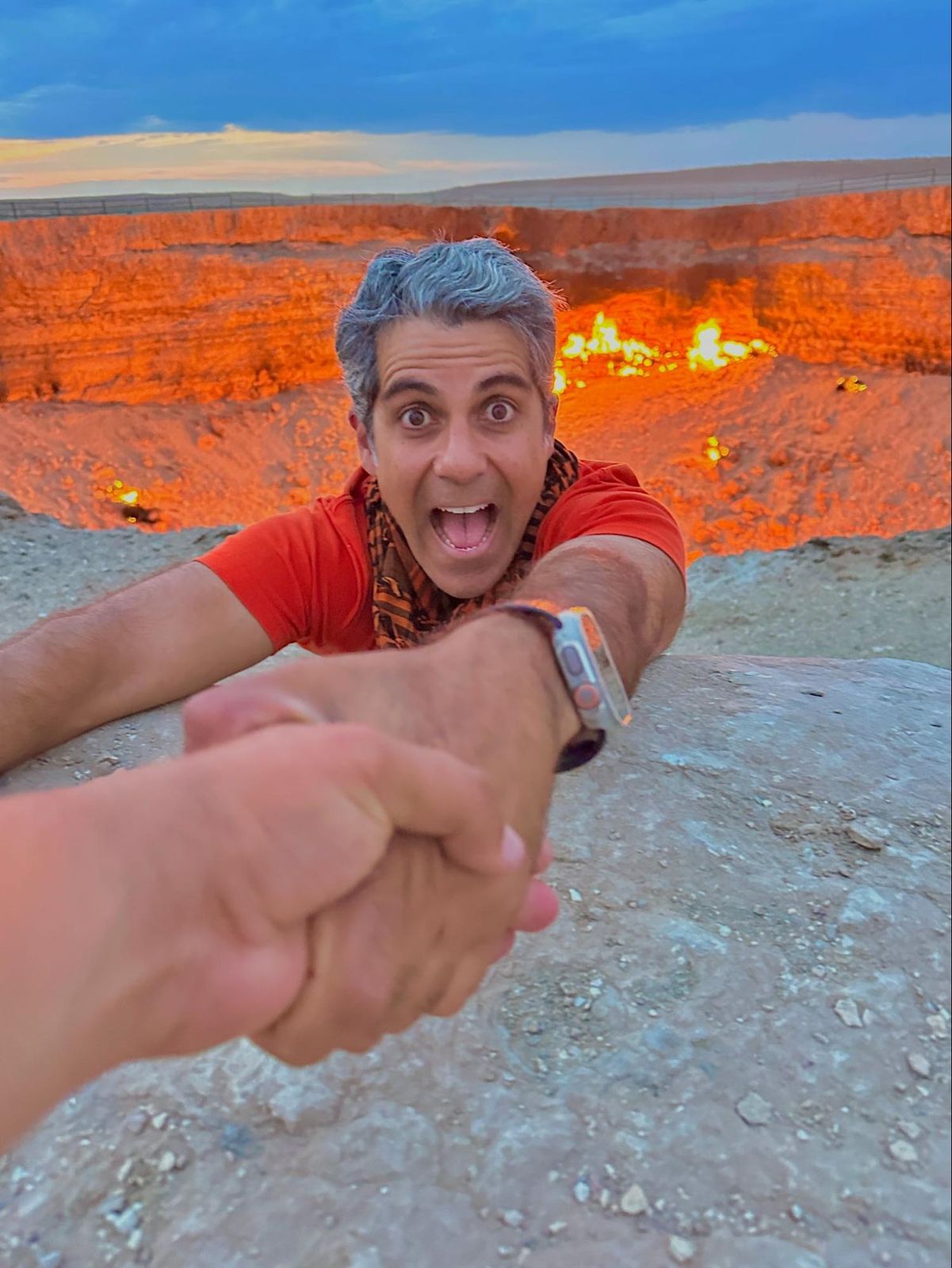
The Darvaza Gas Crater: The final major stop on my journey was the one I had been waiting for: Darvaza, the famous burning gas crater in the Karakum Desert. I have always loved exploring deserts, perhaps because of my Middle Eastern background, so I was excited to spend time in the enormous desert landscape that covers over 70% of Turkmenistan.
We drove for several hours through the Karakum, passing small settlements and stretches of largely empty terrain. As darkness approached, I started looking for the glow that I had seen in so many photographs. And then, finally, there it was!
The Darvaza Gas Crater, often called the Gates of Hell, was unlike anything I had seen before. Standing at the edge and looking down into the burning pit was surreal. The flames illuminated the crater from below, creating an incredible scene against the darkness of the desert.
I had seen countless photos and videos of the crater, but being there in person was a completely different experience. We spent the night nearby in the desert, and I had a chance to appreciate the crater late into the evening and take in the vastness of the surrounding landscape before beginning the journey back to Ashgabat.
AFTERWORD
My trip to Turkmenistan was years in the making, and I am so glad I finally made it happen. The country certainly has its share of odd attractions and policies, and I understand why those things generate so much curiosity. But I think visitors miss the point if they focus exclusively on those oddities.
What made my experience special was the contrast between the modern capital, the Caspian coast, the incredible canyons, and the raw beauty of the Karakum Desert. I also appreciated the culture, food, and hospitality of the people I met along the way.
I owe a special thanks to Murad and Tim, who made the trip possible and helped me experience so much of the country in just five days. Turkmenistan is certainly unusual, but there is much more to this country than what you see in short social media clips.
TRAVEL TIPS
PHOTOGRAPHY: Be careful when photographing government buildings, security installations, and other sensitive locations. Tim frequently reminded me when photography was restricted. When in doubt, ask first.
DESERT TRAVEL: Bring warm clothing for the evenings, even if the daytime temperatures are hot. Weather conditions can change quickly, and strong winds can make camping uncomfortable. I learned that the hard way at Yangykala!
TRAIN TRAVEL: If you're planning a similar route, consider taking the overnight train from Ashgabat to Turkmenbashi. It saves a day of driving and gives you a chance to experience local transportation. Confirm schedules and ticket arrangements with your guide.
EXTRA TIME: If you have additional days, consider visiting Merv, one of Central Asia's great historical cities. It wasn't possible on my five-day itinerary, but it would be high on my list for a return visit.
Stay Curious. And I look forward to seeing you on my next Final50 journey!
Travel Note: The information in this blog reflects my experience at the time of travel. Visa requirements, transportation, costs, and other travel conditions may change, so always verify the latest information before planning your trip.