
SETTING THE SCENE
The Solomon Islands feel like they're literally on the other side of the world. Before my trip, I didn't know a whole lot about the country, other than the fact that John F. Kennedy almost drowned off one of its islands during World War II. But as someone who read about the Battle of Guadalcanal as a kid, I knew this was one of the most important battlegrounds of the war in the Pacific, and I was super eager to see it for myself.
The visit was part of a crazy trip across the South Pacific, with Brisbane serving as one of my bases, and the Solomon Islands became my 170th country. The country is made up of more than 900 islands, but with only a few days, I decided to base myself on the main island of Guadalcanal, in and around the capital, Honiara. I have to admit, Hon-ia-ra was really hard for me to pronounce!
Even with limited time, I was determined to hike, dive, eat, and get a real taste of island life. And I did, from walking straight off a beach onto World War II shipwrecks to watching one of the best sunsets of my year from a former battlefield.
TRIP PREP
FLIGHTS: I flew from Brisbane to Honiara on Solomon Airlines, and the flight wasn't too badly priced, which was a relief. You can also fly in from Fiji, Vanuatu, and Papua New Guinea. Fun fact: you land at Henderson Field, the same airfield that was at the center of the Guadalcanal campaign. I arrived right on the cusp of the rainy season, so expect heat, humidity, and the occasional downpour.
ACCOMMODATIONS: Hotel prices on Guadalcanal seemed way out of line with what you get. I stayed at the Grace Hotel, which was built by Chinese contractors. The rooms were nicely furnished and clean, and the location was great, with a souvenir market next door and the National Museum just down the road. But it was truly not worth what I paid. There are guesthouses as well, but you'll need to do some digging to find something reasonable.
GETTING AROUND: You can rent a car or hire a driver to reach more distant places, but again, the costs are high. Since I only had a few days, I stayed fairly local and used a driver to visit the World War II battlefields. Cabs and local minibuses can also get you from one side of the capital to the other.
MONEY & FOOD: Given the strong presence of Chinese developers on Guadalcanal, there are plenty of Chinese food options. There are also small places serving a mix of local and international food, which I enjoyed. On my first day, I got lucky and found a spot with hearty local food and surprisingly amazing coffee. For breakfast, Breakwater Café was great, but pricey.
DIVING & EXCURSIONS: I'm not a huge diver, and as anyone who followed my trip to Palau knows, I have trouble equalizing the pressure in my ears. But I couldn't come to the Solomon Islands and skip the wreck diving! I dove with Emperor Divers, and thankfully, our group was small and relaxed, so I could take my time and equalize at my own pace. Note that many of the dive shops in the area had gone out of business, so Emperor was the best option available, and they were solid (look up Carolina).
LANGUAGE: English is the official language, but only a small share of the population speaks it fluently. Most people speak Solomon Islands Pijin, an English-based creole, and there are around 70 local languages across the country.
JOURNEY JOURNAL
Exploring Honiara: After landing, I went straight out on a walking tour of the city, even though it was around 85 to 88 degrees and super humid. My first stop was the National Museum.
The museum is small, but it covers thousands of years of history, from early Melanesian seafarers to World War II battle artifacts and the present day. I was amazed to learn that people have lived on these islands for around 30,000 years. It gave me a much better appreciation for the culture and heritage of the Solomon Islands.
I also learned that the country has banned major single-use plastics, including plastic shopping bags, straws, and styrofoam containers, and is encouraging people to use leaf bags and other reusable alternatives. What a statement for a small island nation!
Parliament: From there, I passed the Parliament building on a hill overlooking the city. The Solomon Islands has been independent since 1978 and is a constitutional monarchy, which means King Charles is also the king of the Solomon Islands.
The Coastwatchers: Nearby is Unity Square, with what I was told is the tallest flagpole in the South Pacific, located right in front of the smallest U.S. embassy I've ever seen. There's also the Coastwatchers Monument.
During World War II, the Coastwatchers were a secret intelligence network operating behind enemy lines. The group included Allied officers, mostly Australian and British, along with Solomon Islanders who knew these jungles and waters better than anyone. Using hidden radios, they sent early warnings of Japanese attacks. Two Solomon Islander scouts working with them, Biuku Gasa and Eroni Kumana, found JFK and his crew after his boat, PT-109, was sunk.
Point Cruz and Ironbottom Sound: The monument overlooks the port at Point Cruz, the country's main economic lifeline. It handles almost all international shipping, as well as the ferries connecting the islands.
Right in front of the port is Ironbottom Sound, which got its name from the dozens of warships and hundreds of aircraft that sank there during the war. Knowing that so much history was lying just beneath the surface made me even more excited for my dive the next day.
The Central Market: Next, I visited the Honiara Central Market, the busiest market in the country, with a main hall built with Japanese aid. The real engine behind the market is the "Market Mamas," women who wake up before dawn and travel by truck or canoe from their villages to sell taro, sweet potatoes, coconuts, tropical flowers, betel nut, and just about everything in between.
I was impressed by the homemade coconut oils, and right out back, fishermen pull their boats ashore to sell the morning catch. It's literally sea to table! It was one of the largest markets I've seen in the South Pacific.
Walking Through Honiara: As the sun started to go down, I walked along the main strip of Honiara to get a sense of daily life. One thing that stood out was the Chinese presence, which was stronger here than almost anywhere else I've visited in the region, from China Aid buildings to Chinatown. The Solomon Islands switched its diplomatic recognition from Taiwan to China in 2019, and China has since invested heavily in infrastructure projects. It's a diplomatic quid pro quo: in return for those investments, China has gained extensive mineral and fishing rights in the country. This is a very common trend throughout many parts of the world I have visited in recent years.
I also noticed the strong presence of Western religious groups, such as Jehovah's Witnesses, which I had also seen throughout Tonga, Samoa, and Fiji.
Jacob's Ladder: When I first heard about Jacob's Ladder, I honestly assumed it was an actual ladder! It's actually a massive concrete staircase built into the hillside.
Honiara is built on steep ridges and deep ravines, so when heavy rains wash out the dirt roads, these steps become a lifeline for people moving between the valleys and the main roads. After a full day of exploring, I headed back to the hotel to get a good night's sleep before the big dive.
Diving the Bonegi Wrecks: The next morning, after a hearty breakfast, we drove about 25 minutes west of the capital to Bonegi Beach. What makes this place so special is that you don't need a dive boat. You simply gear up and walk off the black sand beach straight onto the wrecks. That was a total first for me!
Resting just offshore are two large Japanese transport ships, known as Bonegi I and Bonegi II, which were bombed and beached by Allied forces in 1942 during the Battle of Guadalcanal. Swimming around them was insane! We passed rusted gun mounts, open cargo holds, and giant propeller shafts, all covered in coral and surrounded by tropical fish.
Meeting Oscar: One of the best parts of the day was meeting Oscar, an Australian guy in our dive group. He mentioned that he might travel to Tuvalu, and sure enough, a few days later I ran into him relaxing on a random beach there!
That's honestly one of the best parts of traveling: meeting people, letting your guard down, and exploring new places together.
The Guadalcanal American Memorial: After the dive, I wanted to learn more about the island's World War II history. We drove through the outskirts of town, which felt much more rural and humble than central Honiara, and up to the Guadalcanal American Memorial on Skyline Ridge.
Dedicated in 1992, 50 years after the battle, the memorial overlooks the main battlegrounds and the Florida Islands and Savo Island in the distance. Guadalcanal was a major turning point in the war because it was the first major Allied offensive against Japan in the Pacific.
The six-month campaign was brutal. More than 7,000 Allied troops lost their lives, and Japanese losses were far higher, with many soldiers dying from disease and starvation in the jungle before Japan finally withdrew in February 1943.
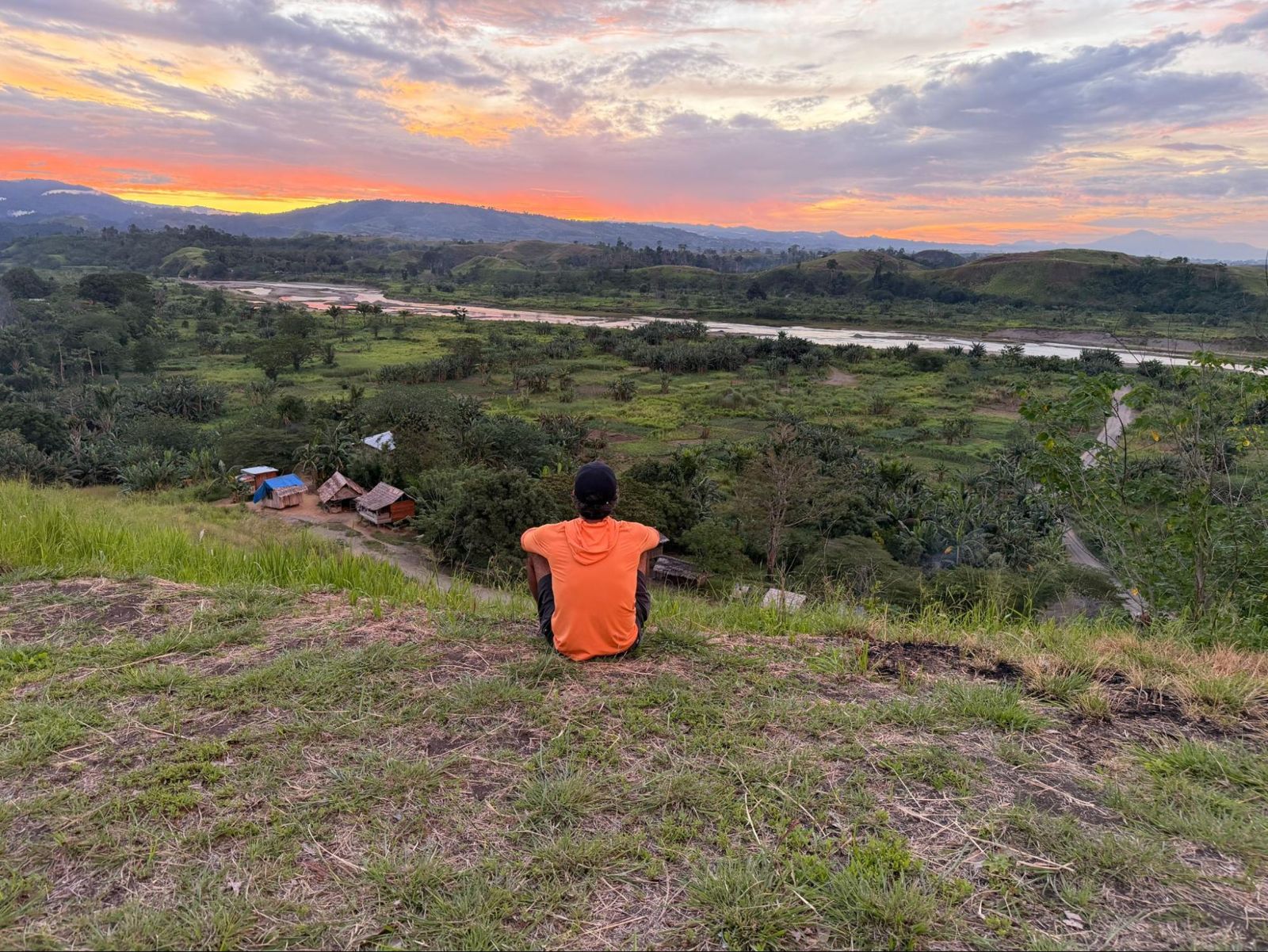
Sunset on Bloody Ridge: From there, we went to Edson's Ridge, also known as Bloody Ridge, overlooking Henderson Field. The Americans built a perimeter around the airfield, and the Japanese kept trying to break through, because whoever controlled it would control the skies over the surrounding waters. This is the kind of fighting that was very well depicted in the movie 'The Thin Red Line'.
The hills themselves look almost like little molehills, but every inch was fought over, often hand to hand. The remains of soldiers from both sides are still believed to be buried there.
We arrived just as the sun was setting. Looking out at the peaceful villages and the landscape, which doesn't look all that different from how it did more than 80 years ago, it was mind-blowing to think about the chaos and violence that took place right there. The contrast between then and now was unreal. It was easily one of the best sunsets of my year and the moment of the trip for me.
The "Japanese" Tunnel: As a cherry on top, our driver told us he knew about a tunnel built by the Japanese during the war. We went inside and found it dark and super creepy. Walking through it felt so raw, real, and battle-scarred. Well, until we got back to the entrance and I noticed a sign saying it had actually been built just a few years earlier by a crew from New Zealand! Still, it gave me a good idea of what the real wartime tunnels must have been like.
A Morning Run: On my last day, I continued my tradition of going for a run in every new country. Even at sunrise, the heat and humidity hit me like a brick wall, and I was soaked within minutes. But running through the neighborhoods was a great way to wrap up the trip and see a little more of daily life.
AFTERWORD
I only saw a small part of one island out of more than 900, but in just a few days, I got an amazing sense of the culture, food, traditions, nature, and modern history that have shaped the Solomon Islands.
Diving the Bonegi wrecks straight from the beach was a first for me, and standing on Bloody Ridge at sunset after reading about Guadalcanal as a kid is something I'll never forget. I also didn't expect to learn so much about the country today, from the Market Mamas to the growing Chinese influence.
This is an incredible place and well worth the journey. Thank you for your hospitality, Solomon Islands!
TRAVEL TIPS
WRECK DIVING: If you're a newer or more cautious diver, Bonegi is perfect because you can shore dive at your own pace without a boat. If you want to explore the deeper wrecks of Ironbottom Sound, book a dive boat well in advance, since those dives require more technical planning.
WWII SITES: Hire a driver for an afternoon and visit the Guadalcanal American Memorial, Henderson Field, and Bloody Ridge in one loop. Try to time it so you reach Bloody Ridge at sunset.
UNEXPLODED ORDNANCE: Large amounts of World War II munitions are still scattered across the islands, so never enter areas marked as containing ordnance.
CROCODILES: Saltwater crocodiles live in the Solomon Islands, so don't swim or wander into remote, unfamiliar waters, especially rivers and mangroves.
WATER: Don't drink the tap water. Stick to bottled or treated water.
Stay Curious. And I look forward to seeing you on my next Final50 journey!
Travel Note: The information in this blog reflects my experience at the time of travel. Visa requirements, transportation, costs, and other travel conditions may change, so always verify the latest information before planning your trip.