
SETTING THE SCENE
I was on a mission to explore some of the most remote countries in the Pacific, and the Federated States of Micronesia was one of the destinations I was curious about. The truth is, I hadn't done a lot of research before arriving, and I wasn't entirely sure what to expect. Different people told me about the diving, snorkeling, waterfalls, and World War II wrecks, but one place really caught my attention: Nan Madol, often referred to as the Atlantis of the Pacific.
When I looked it up, I was floored! Here was an ancient complex of massive stone structures and canals, built on artificial islets in the middle of the Pacific Ocean. How did these people build something so elaborate without modern machinery? Who were they? And why was the place eventually abandoned? As someone who loves history and ancient civilizations, I knew I had to see it for myself.
Micronesia is made up of four states: Yap, Chuuk, Pohnpei, and Kosrae, spread across a vast area of the western Pacific. Each has its own traditions, geography, and attractions. Given the limited time I had, I decided to focus on Pohnpei, a mountainous and incredibly green island that is home to both the country's capital, Palikir, and the ruins of Nan Madol.
What I discovered was a destination with fascinating history, remarkable natural beauty, and some incredibly kind people who made my trip much more memorable than I had anticipated.
TRIP PREP
FLIGHTS: Getting to Micronesia is not easy. I traveled through the Pacific using United Airlines miles, with flights connecting through the Marshall Islands and onward toward Guam and Palau. United's island-hopping flights are among the main ways to reach Pohnpei. Just remember that schedules can be limited, and a delayed flight can quickly affect your plans. My own flight was delayed, which meant I lost some valuable exploring time on my first day.
VISA: As an American citizen, I did not need to obtain a tourist visa in advance for my visit to the Federated States of Micronesia. However, you should always verify the latest entry rules, passport requirements, and permitted length of stay before traveling.
ACCOMMODATIONS: I stayed at the Island Palms Hotel & Restaurant in the Kolonia area. I found the staff friendly, the restaurant convenient, and the location useful for exploring the town. There aren't nearly as many hotel options as you might find in more developed Pacific destinations, so I would recommend organizing your accommodations in advance.
GETTING AROUND: Taxis are a practical option for short journeys, but if you want to explore the island, I strongly recommend finding a local driver or guide. I met Augustine, a local taxi driver, who agreed to spend the day showing me around. He ended up being an incredibly knowledgeable and hospitable guide. One thing I noticed was that many imported Japanese cars had steering wheels on the right, even though vehicles drive on the right side of the road, as in America. That alone made me happy I wasn't trying to navigate the island myself!
MONEY & FOOD: The local currency is the U.S. dollar, which makes things convenient for American travelers. There are restaurants and small shops around Kolonia, but don't expect a huge selection. I tried several local places and also found a good coffee spot at One World Plaza. Carrying some cash is advisable when venturing outside town.
ACTIVITIES: If you plan to dive or snorkel, look into local operators such as the Surf and Dive Club. Tours can be expensive, so it's worth organizing them ahead of time if you have a short itinerary.
JOURNEY JOURNAL
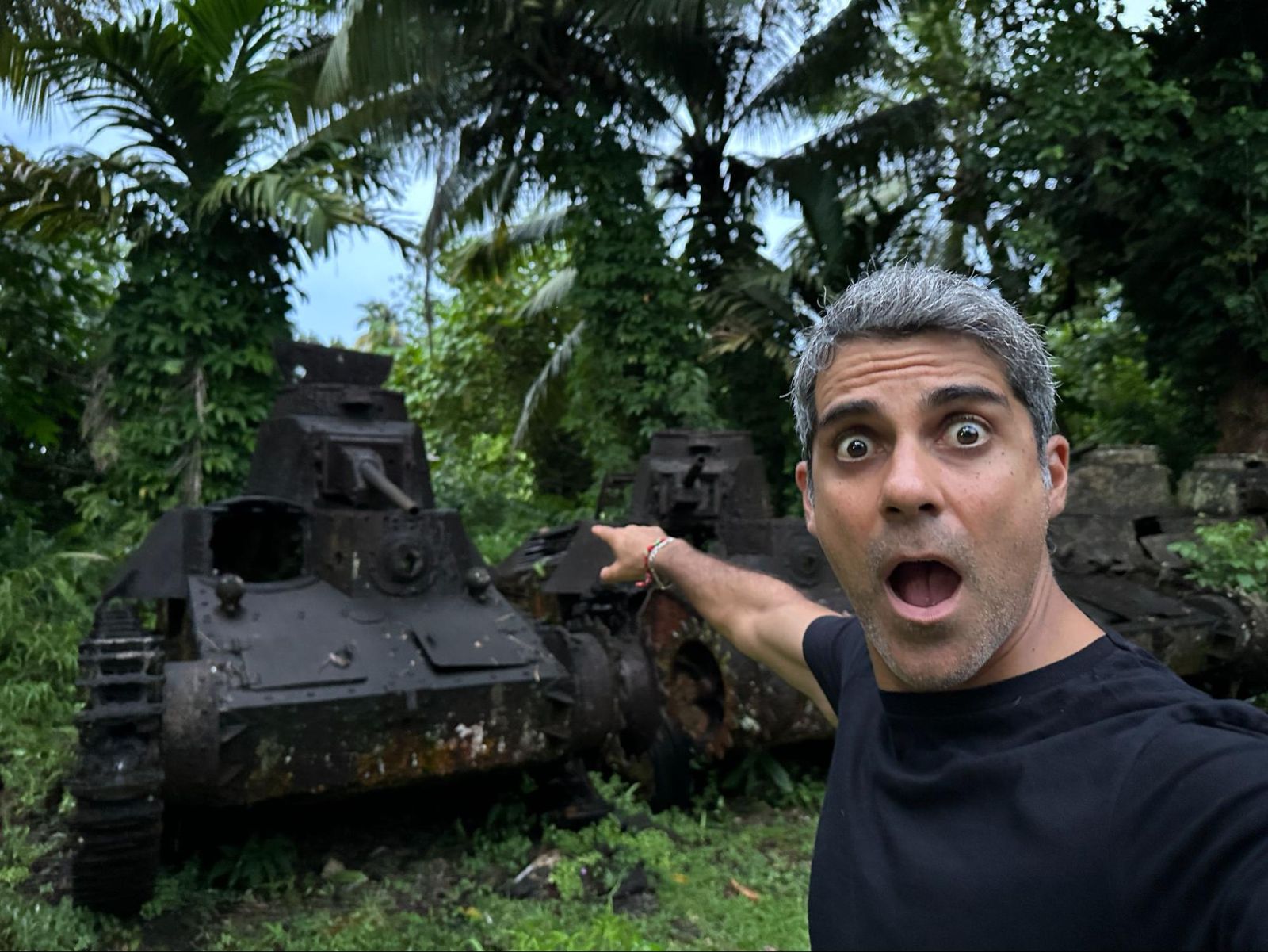
World War II History: By the time I arrived in Pohnpei, my flight had been delayed and I didn't have much daylight left to explore. So I looked at a map and found the Japanese Tank Graveyard, literally a five-minute walk from my hotel!
Now, I'm a huge World War II history buff, so I had to visit it. I walked over and found several old Japanese tanks sitting out in the open, with parts of their original machinery still visible. I couldn't believe it. Usually, you have to visit a museum or a preserved military site to get this close to historical equipment, but here they were, sitting in the middle of town.
Meeting Augustine and Exploring Pohnpei: The following morning, I met Augustine, who was going to take me around Pohnpei. We had a packed itinerary, including Nan Madol, a waterfall, the national capital, and a hike to some old Japanese military fortifications.
What immediately struck me was how different Pohnpei looked from the Marshall Islands, which I had visited on the same Pacific journey. While the Marshall Islands are largely low-lying coral atolls, Pohnpei is mountainous, with thick tropical vegetation, rivers, and waterfalls. It is also one of the wettest inhabited islands in the Pacific, receiving tons of rain each year.
As we drove across the island, Augustine told me about his life growing up in Micronesia. He had spent time visiting his brother near Oakland, California, and I was curious to hear how he compared life in America with life back home.
His answer was interesting. He told me that people on the island could grow their own food, fish, and live on family land, whereas in America, everyone seemed to work nonstop just to pay their bills. He even jokingly suggested that I should move to Micronesia and start a business with him! Here was someone who had experienced both worlds and genuinely appreciated the simplicity of life on his island. It's the kind of perspective I love getting when traveling because it challenges the assumptions we make about what constitutes a good life.
Along the way, Augustine also explained that some families traditionally bury their deceased relatives close to their homes rather than in large communal cemeteries. I found that fascinating, especially how differently cultures approach death, family, and ancestral connections.
But one thing that really surprised me was the sheer number of abandoned vehicles along the roads. It seemed like everywhere we turned there was another broken-down car being reclaimed by vegetation. From what I learned, importing parts and repairing old vehicles can be costly, and removing them from an island with limited waste-management infrastructure is another major challenge. Augustine explained that outside assistance has sometimes been needed to collect and ship abandoned vehicles away.
Nan Madol, the Atlantis of the Pacific: Eventually, we arrived near Nan Madol and started walking through the jungle toward the ruins. I have to admit, the place felt a little mysterious and even creepy. Then, suddenly, we began to see canals cutting through the vegetation and enormous stone walls emerging from the jungle. I was absolutely blown away!
Nan Madol was the ceremonial and political center of the Saudeleur dynasty, which ruled Pohnpei centuries ago. The complex includes more than 90 artificial islets separated by canals, which is why it has sometimes been called the Venice of the Pacific. But what makes it so extraordinary is how it was built. Enormous basalt stones, some weighing several tons, were transported and stacked to create walls, tombs, and ceremonial structures. How did people manage to accomplish such an engineering feat without modern machinery? I even tried lifting one of the smaller stones and almost threw out my back! These things were HEAVY.
Walking through the ruins reminded me of exploring Machu Picchu in Peru and even some of the ancient sites in Egypt. There was something remarkable about seeing how an ancient civilization had managed to integrate massive structures with the surrounding landscape.
I can't tell you how happy I was to have made the trip. Nan Madol absolutely lived up to its reputation as the Atlantis of the Pacific!
Waterfalls, Palikir, and Sokehs Ridge: After leaving Nan Madol, Augustine took me to a waterfall hidden within Pohnpei's thick vegetation. We walked along a jungle trail, and when we finally reached the falls, I couldn't resist getting into the water. It was refreshing, and the best part was that we pretty much had the place to ourselves.
From there, we drove toward Palikir, the national capital of Micronesia. I always find it fascinating when a country builds a relatively new capital, especially in places like Brasília in Brazil. Palikir is quite different from the busy administrative centers you might expect. The national government buildings are spread across a quiet area, surrounded by tropical greenery.
But the day wasn't over yet. Augustine dropped me near the foothills of Sokehs Ridge, where Japanese forces had constructed military defenses during World War II. I love hiking, so I decided to make my way up the mountain to see the old gun emplacements and enjoy the view.
Now, this hike was no joke! The vegetation was thick, the trail wasn't always easy to follow, and at several points I genuinely wondered whether I was going to get lost.
Thankfully, I eventually reached one of the old gun positions, overlooking the bay. And the view was absolutely worth the effort. I could see Kolonia, the coastline, and the surrounding landscape stretching into the distance.
Snorkeling and Coral Bleaching: Another activity I wanted to experience was snorkeling off Pohnpei, in an area known as Manta Road. The next day, we headed out by boat hoping to see some of the marine life that inhabits the surrounding reefs. But one thing that really stood out to me wasn't the wildlife. It was the condition of the coral.
I had heard about coral bleaching before, but I hadn't fully appreciated what it looked like until this trip. One of the other tourists on the boat worked in environmental protection and explained how rising water temperatures can stress corals, causing them to expel the algae that normally live in their tissues. What a coincidence that this guy had actually met my brother years earlier in the Galápagos Islands, where my brother works. Small world!
It was quite something to see the effects of coral bleaching firsthand, especially in a place where the surrounding ocean is such an important part of local life.
Trying Sakau: Before leaving Pohnpei, I wanted to learn more about sakau, the traditional drink. I eventually met two locals who explained how it is made. The process involves cleaning and pounding the roots of the kava plant, mixing them with water, and using hibiscus fibers to extract the liquid. The finished product has a thick consistency and a very weird, numbing taste. Still worth the experience for sure!
AFTERWORD
I came to Micronesia without high expectations, mostly because I didn't know enough about the country. But I left with a much greater appreciation for its ancient history, culture, natural environment, and people.
Nan Madol was definitely the highlight. I never imagined I would find a historical site like that, with such impressive engineering and fascinating mysteries, in the middle of the Pacific Ocean. But I was also grateful for my time with Augustine, who helped me understand daily life in Pohnpei and shared perspectives that I wouldn't have learned from simply visiting the main attractions.
There is still so much more to explore across the other states of Micronesia, from the famous shipwrecks of Chuuk Lagoon to the traditional culture of Yap and the mountainous landscapes of Kosrae.
I definitely hope to return one day and experience more of this Pacific nation.
TRAVEL HACKS
NAN MADOL: Don't miss this UNESCO World Heritage Site. Wear proper walking shoes, expect muddy trails, and be prepared for heat and humidity. Confirm access arrangements and fees before visiting.
WORLD WAR II HISTORY: If you're interested in military history, check out the Japanese tank remains in Kolonia and the old fortifications on Sokehs Ridge. Some sites are not well developed for tourism, so exercise caution.
SAKAU: If you're curious about traditional island culture, learn about sakau and its ceremonial importance. Be aware that kava can have side effects and may interact with medications.
EXTRA TIME: If you can extend your trip, consider visiting Chuuk, Yap, or Kosrae. Each state offers a different experience, and I only scratched the surface of what Micronesia has to offer.
Stay Curious. And I look forward to seeing you on my next Final50 journey!
Travel Note: The information in this blog reflects my experience at the time of travel. Visa requirements, transportation, costs, and other travel conditions may change, so always verify the latest information before planning your trip.