SETTING THE SCENE
Before planning my trip, I didn't know a lot about Benin. I knew it was a small country in West Africa, and I had seen the movie 'The Woman King', which tells the story of the all-female warriors who once served the kings of Dahomey. But I was surprised to learn that voodoo originated here, and that the coastal city of Ouidah was one of the major departure points of the Atlantic slave trade.
In all honesty, Benin was an added side trip. I was already in the region visiting Gabon and São Tomé, and Benin fit neatly into the route as my 167th country. I only had about two days on the ground, so I decided to base myself in Cotonou and take a day trip to Ouidah.
I didn't expect much from such a short visit. But between a young driver named Paguiel who became my guide, a temple full of pythons, and some of the most beautiful street art I've ever seen, Benin left a mark on me I could not have predicted.
TRIP PREP
FLIGHTS: I flew into Cotonou from Libreville, Gabon. You can also reach Cotonou from France, Turkey, and a number of other African countries, which makes it one of the more accessible countries in the region.
VISA: The visa process was super easy. As an American citizen, I applied online and received my e-visa within a few hours. You can easily handle it on your own. Just don't forget your yellow fever vaccination card, because you'll need it to enter the country.
ACCOMMODATIONS: Since I used Cotonou as my base, I stayed at L'Address, a hotel in a central part of town. The area along the main boulevard near the waterfront, not too far from the airport, is a great and safe place to stay. Even better, it's right next to the murals, which ended up being one of the highlights of my trip.
GETTING AROUND: There's an app called Yango that works just like Uber. Since I didn't have a local phone number, I couldn't register myself, but the hotel receptionist was kind enough to do it for me. My driver, Paguiel, was a 24-year-old local who seemed really down to earth, and we quickly became friends. I asked if he would stay with me for the day, and he agreed not only to take me to Ouidah but also to show me around the capital. He was awesome, and it turned out to be one of the best human connections I made all year.
You'll also see motorcycle taxis everywhere in Cotonou.
FOOD: On my first night, I had a plate of fish, beef, pepper sauce, onions, and a mild cassava-based starch. But the highlight was a farewell dinner at a restaurant near the beach known for its fish.
TRIP PLANNING: Two days was enough to see the highlights of Cotonou and take a day trip to Ouidah, about an hour's drive west along the coast. I arrived in the early evening on the first day, spent the second day in Ouidah and Cotonou, and went for a run on the third morning before my early afternoon flight. If you want to attend a voodoo ceremony or visit the lake village of Ganvié, I'd recommend adding at least another day.
JOURNEY JOURNAL
First Impressions of Cotonou: When I arrived, I was immediately taken aback by the infrastructure and modern feel of the airport and the parts of the capital around it. But what really grabbed my attention was the street art.
Along the main boulevard, there's a long wall separating the port from the city, and it's covered with murals that seem to stretch for miles. Many of them pay homage to the kingdom's warriors, and artists from across the region came together to create them. Benin was such a warrior culture that it was even called the "Black Sparta." Thankfully, my hotel was right in the area, so I knew I would have time to come back and look at the murals one by one.
That first night, I went to see the enormous Amazon statue in the heart of the city. It pays tribute to the all-female warriors of the Kingdom of Dahomey, and seeing it in person was incredibly powerful. Then I sat down for dinner, and I'll be honest, I had already started devouring my plate before I could even explain what was on it!
Walking the Slave Route: The next day, Paguiel and I made our way to Ouidah, a city that is fascinating from both a historical and a cultural perspective. Our first stop was the old slave market in the center of the city. Local officials have placed large metal balls to mark where enslaved people stood when they were bought and sold before being forced to walk in chains about 2-3 kilometers to the shore.
It's estimated that around a million people were shipped from Ouidah over the course of the Atlantic slave trade. Many were prisoners of war, and others were taken from their villages and passed through different hands, local and European, before being sold to the slave traders. It was absolutely heart-wrenching to think about.
In memory of those who made that march, I decided to walk the same route from the market to the beach. I looked at the buildings and the countryside along the way, and every step felt heavy knowing that so many people had once walked the same path in chains.
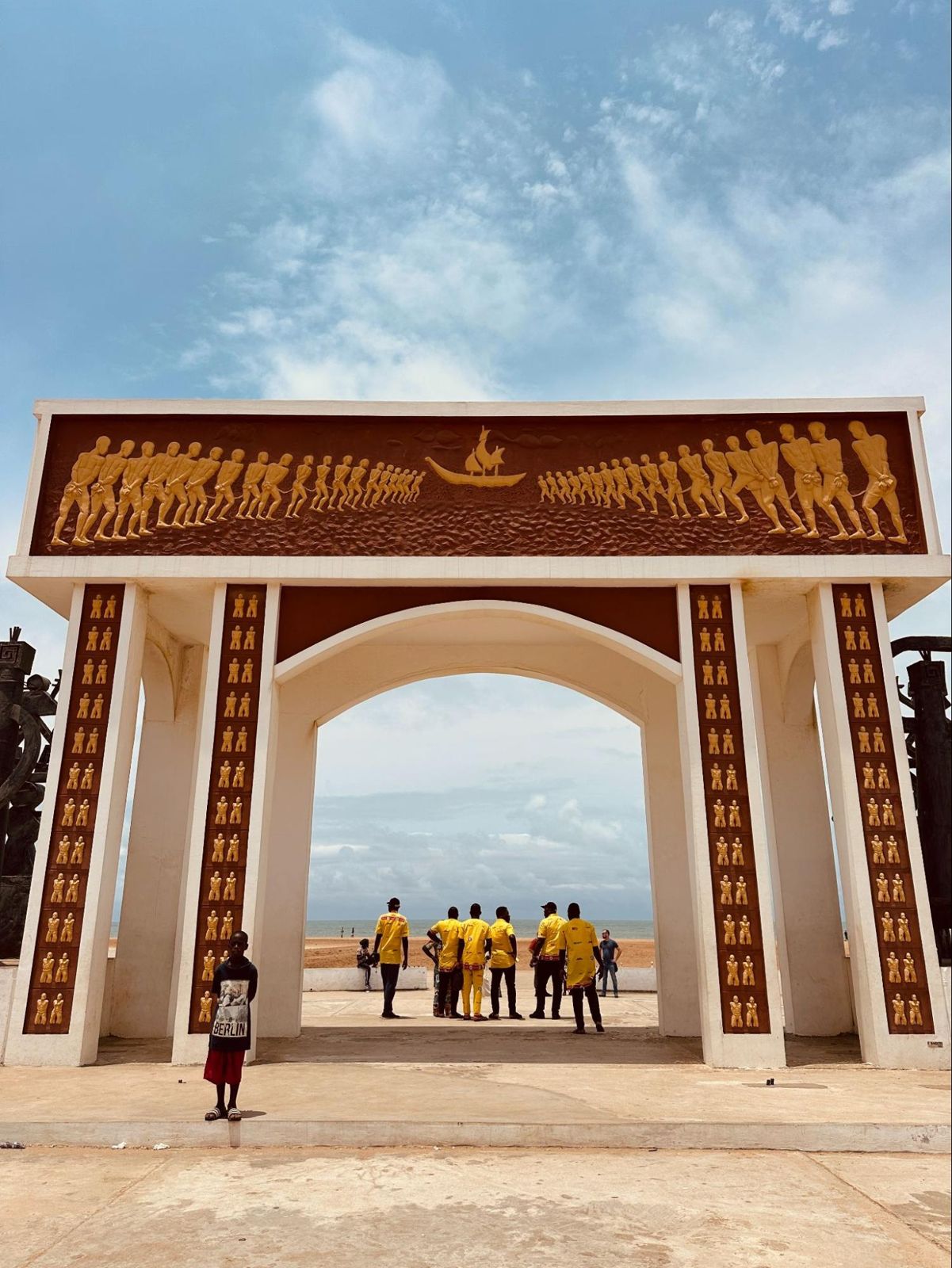
The Door of No Return: I finally reached the Door of No Return, a large arch on the beach surrounded by sculptures and murals honoring the people who left from that spot. Standing there, looking out at the Atlantic, it was impossible not to think about how depressing and evil human nature can be, subjugating people for hundreds of years.
I must have sat on that beach for almost an hour, just looking into the distance and thinking about the people who saw Africa for the last time from right there. It was one of the most emotional moments of the trip, and the moment I remember most from Benin.
The Temple of Pythons: Since it was a Friday, I prayed at the local mosque before heading to a completely different kind of religious experience: the Temple of Pythons, which is really ground zero for voodoo.
The story I heard is that this area used to be forest, and the pythons kept rodents away from the farmers' crops, so people began to revere them. They became part of the voodoo faith, which is based on the idea that every tree, rock, animal, and even piece of iron has its own spirit. The pythons are fed once a month, roam freely, and are never harmed.
Of course, I had to put one around my neck. I was told it doesn't bite, and it slowly wrapped itself around me like I was a rodent it was about to eat. Don't judge me! What I found so funny was that Paguiel, who grew up here, refused to put the snake on himself. He just panicked!
Voodoo and the Basilica: What really surprised me was that right across from the temple stands a large Catholic basilica, one of the oldest in West Africa. Many people in Benin practice both Christianity and voodoo, and seeing the two side by side was a real culture shock for me.
Voodoo is often misunderstood, and the Hollywood version has very little to do with what people actually practice. That's why it's so important to stay curious and keep an open mind, especially when learning about the traditions of others. One of the best parts of traveling is having the chance to understand these beliefs firsthand.
Red Star Square: Back in Cotonou, we stopped at Red Star Square, home to a monument built in the 1970s when Benin was a Marxist-Leninist state. On top stands a shirtless figure holding a rifle and a hoe, and from above, the square is shaped like a star.
Benin gained independence from France in 1960 and went through years of political turmoil, including a long communist period. Then in 1990, the country began its transition to becoming one of Africa's first multiparty democracies. I found it fascinating that the monument still stands in the middle of the city as a meeting point and a reminder of that era.
Dantokpa Market: Next, we went to Dantokpa Market, one of the largest open-air markets in West Africa. Nothing could have prepared me for how wild this place was! There were thousands and thousands of stalls stretching in every direction.
I called it controlled chaos, but honestly, I'm not sure it was controlled! If I had lost Paguiel, it would have been a wrap. I would have been stuck in there forever, wandering up and down the tiny alleys drowning in stalls selling everything from streetwear to oranges and audio equipment to plumbing tools.
A Farewell Dinner: We ended the day at a beach just outside the city center. It was bittersweet saying goodbye to Paguiel, especially given how great he had been at introducing me to his country.
I stayed in the area for a farewell dinner of the locally famous fish. Then I prayed to the transportation gods and took a motorcycle taxi back to the hotel!
The Murals of Cotonou: But before I called it a night, I found myself drawn back to those murals. I spent over an hour walking past each one, created by local and regional artists. Each tells a story or celebrates a life event, a historic moment, or a point of pride for the people of Benin. Make sure to check out my vlog to see them for yourself.
The next morning, I continued my tradition of going for a run in every new country, right along the same wall. Honestly, the murals were one of the most unforgettable experiences I've had on my travels.
AFTERWORD
Benin was such an unexpected surprise. I came thinking of it as a quick side trip and left wishing I had more time.
I loved the street art, the food, and learning about the different faiths that coexist here, from the mosque to the basilica to the Temple of Pythons. Walking the slave route in Ouidah and sitting at the Door of No Return was one of the most emotional experiences of my year, and the Amazon statue was a powerful reminder of the country's warrior past.
But above all, I'll never forget the hospitality of the people, especially Paguiel, who made my short visit so much more memorable.
TRAVEL TIPS
HIRE A DRIVER FOR THE DAY: Instead of booking separate rides, ask your Yango driver whether he'll stay with you for the whole day. It's safer, more convenient, and in the long run more affordable, especially for the trip to Ouidah. You can then negotiate and pay the driver offline in local cash.
VOODOO CEREMONIES: I didn't have time to attend a ceremony. If that's a priority, consider planning around Voodoo Day on January 10, when celebrations take place across the country, and ask locals how to attend respectfully.
MOTORCYCLE TAXIS: They're everywhere in Cotonou and very convenient, but always wear a helmet.
PHOTOS: Don't take pictures of government buildings or military installations. That's a good rule to follow throughout Africa.
THE NORTH: Avoid the northern border areas near Burkina Faso, which are considered dangerous.
Stay Curious. And I look forward to seeing you on my next Final50 journey!
Travel Note: The information in this blog reflects my experience at the time of travel. Visa requirements, transportation, costs, and other travel conditions may change, so always verify the latest information before planning your trip.