
SETTING THE SCENE
Angola had been at the very top of my bucket list for years, mostly because of its history, especially its war of independence. But for a long time, it was one of the most difficult countries in the world to visit, at least for American travelers trying to get a visa. So I kept putting it off.
Then, on a trip to Cape Verde, I met Miguel, who is originally from Angola. Hearing him talk about home motivated me even more to finally visit and explore the history, the nature, the food, and the overall vibe of one of Africa's most unique countries.
So when I was looking for countries with more relaxed entry requirements and Angola popped up, it felt like a sign. I booked everything right away, and it became my 169th country. A canceled flight ended up cutting my trip short, so I spent most of my time in and around Luanda. But thanks to Miguel's cousin Kenny, those few days were packed with history, great food, and one unexpected moment in a restaurant that I'll never forget.
TRIP PREP
FLIGHTS: I was already traveling through Africa, and to reach Angola I had to rely on a limited number of airlines, with TAAG, the national carrier, being the main option. Now here's the thing: my one-way flight from São Tomé to Luanda was probably the most expensive ticket I've ever bought for the distance. And what's worse? The flight was canceled! I had to spend an unexpected extra night in São Tomé, and the delay wiped out my plans to explore outside the capital. Of course, I can say this calmly in hindsight, but at the time I was royally pissed, especially given how much that ticket cost. If you're flying from farther away, carriers such as Emirates, Ethiopian Airlines, Turkish Airlines, Air France, and TAP serve Luanda.
VISA: For years, getting a visa to Angola was very difficult for U.S. citizens. At the time of my visit, Americans could enter visa-free for short tourist stays, which made the whole trip possible. Check the latest requirements before traveling.
ACCOMMODATIONS: I was very fortunate. I had stayed in touch with Miguel since meeting him in Cape Verde, and when the time came to visit Angola, I reached out to him. He couldn't join me, but he connected me with his cousin Kenny, who was a godsend. I stayed with Kenny in one of the most central areas of the city, and it worked out perfectly.
GETTING AROUND: Kenny took me everywhere on local transportation, including minibuses known as candongueiros, as well as taxis. I wouldn't recommend using the minibuses without a local, though. Outside the capital, I'd strongly recommend hiring a guide. The country is massive, there's so much to see, and some areas can be dangerous, so you really need someone who knows what they're doing.
MONEY & FOOD: The days of Luanda being one of the most expensive cities in the world are long gone. I was careful with my spending, but prices were much more reasonable than I expected, and I didn't have any issues. Side note: I saw the cheapest gas of my life in Luanda, just over $1 a gallon! As for food, Kenny took me to a bunch of local restaurants so I could try the staples, like moamba de galinha, mufete, and funge. When you combine Portuguese cooking styles with local produce and flavors, magic happens.
COMMUNICATIONS: It's easy to get a SIM card, and most international carriers with data plans should work fine.
LANGUAGE: Portuguese is the official language, and English isn't widely spoken. Kenny didn't speak a word of English, so we communicated through Google Translate for almost the entire trip. It worked surprisingly well!
JOURNEY JOURNAL
First Impressions of Luanda: As soon as I landed, Kenny took me to explore downtown Luanda. Driving and walking around, I was immediately struck by the contrasts: wealth and poverty, old and new, war-torn and modern.
Remember, Angola went through centuries of slavery, a 13-year war of independence from Portugal, and a devastating 27-year civil war. But then the oil and diamond boom sent the country into a wild period of development, and you can see the results everywhere you look.
We walked along the waterfront on Avenida 4 de Fevereiro, known as the Marginal, just as the sun was setting. It was absolutely gorgeous and reminded me of the famous boardwalk along Copacabana in Rio. I knew right away that I'd have to come back for a run.
Dinner with Kenny's Family: That evening, Kenny took me to a restaurant that was supposed to be one of the best for moamba de galinha, a chicken stew considered the national dish. It was served with funge, a smooth cassava porridge, and a spicy sauce. So good!
Kenny's family and friends welcomed me with open arms, and that first night I learned so much about the country's history and potential. Honestly, there's nothing quite like having locals show you their world. When I saw the view from their building, I was amazed by how developed Luanda was compared with most other capitals I had visited on the continent.
Oil, Diamonds, and Bullet Holes: Around the city, we passed the original headquarters of Sonangol, the state oil company, which sits next to its massive new tower. It almost felt like a symbol of how much the country itself has grown. In fact, Angola ranks among the top 20 oil exporters in the world, which gives the country a huge source of revenue.
Not far away is a monument to the unknown soldier, and nearby I noticed an older building still marked by bullet holes from the fighting in the 1990s. The civil war flared up again after the 1992 elections and only ended in 2002, following the death of rebel leader Jonas Savimbi. While the oil boom has made some people very rich, the inequality is still enormous.
A Science Museum Surprise: Out of nowhere, Kenny decided to take me to a brand-new science center for kids. To be honest, I couldn't really push back, since he was being such a gracious host.
I hadn't been to a children's science museum in years, so I thought, why not? Alongside the dinosaur exhibits, there was a display of enormous diamonds, including one that was 227 carats. Unreal!
In just an hour, I learned so much about African scientists, the country's natural resources, the symbolism of the Angolan flag, and even how to make soap. Kenny is a genius, and I walked out knowing far more about Angola than when I walked in.
São Miguel Fortress: To jump back into the past, we visited the Fortress of São Miguel, built by the Portuguese in the 1570s on a hill overlooking Luanda Bay. Today, it houses the Armed Forces Museum, which covers everything from the colonial period to the war of independence and the civil war.
That civil war was a major proxy conflict of the Cold War, fought between Soviet-backed and Western-backed factions, and seeing the history up close inside the fort made it feel much more real. The views over the city were incredible, too.
The Iron Palace: Kenny also wanted me to see the Iron Palace, a building with a pretty mysterious past. The story is that the metal structure was designed in Gustave Eiffel's workshop and was being shipped to another part of Africa when the ship ran aground. The Portuguese colonial governor then kept it for Luanda.
It reminded me of a similar iron building I had seen at the Royal Palace compound in Cambodia. The palace fell into complete disrepair during the civil war, but it has since been restored and is now used as a space for the arts.
Souvenirs and the Slavery Museum: We then took our first trip outside the city center to an artisan market about 20 kilometers south, on the road toward the national park. It was calm and not crowded, and after the traffic and pollution of Luanda, I could finally breathe. After some serious negotiating over paintings and traditional clothes, I walked away happy.
Nearby, we visited the National Slavery Museum. The slave trade here began around the 1500s and peaked in the 1700s, with captives sent to Brazil, São Tomé, and beyond to work on plantations growing sugar, cotton, and cacao. It was a depressing but important stop.
Mufete and "Angola País Novo": We wrapped up the day at a local restaurant known for mufete, a traditional Angolan fish dish served with beans, chili sauce, and cassava flour. Then something happened that I totally did not expect.
A young musician came in with a guitar to entertain the guests, and one of the patrons asked him to play "Angola (País Novo)" by Matias Damásio. He played it so beautifully, almost better than the original. While I could only make out a few of the words, seeing the joy and raw emotion of everyone singing along showed me just how much their country means to Angolans.
Given that more than half a million people died during the war of independence and the civil war, it gave me goosebumps. It also reminded me of Cesária Évora's famous song "Angola" from my time in Cape Verde. I just had to record it. These lyrics say it all:
I will speak of this land of glories,
Our Angola of many memories.
I will speak of a people who wanted
To finally be happy now.
Kissama National Park: I had originally planned to stay long enough to see the famous Kalandula Falls and the Black Stones of Pungo Andongo. But because of my canceled flight, I had to scramble just to see a little of Angola's nature. So on my last day, Kenny and I drove to Kissama National Park, a few hours from the city.
The park is massive, covering roughly 4,000 square miles, or about three times the size of Rhode Island, and we saw only a small part of it. During the civil war, the park was almost emptied of wildlife. Then in the early 2000s, Operation Noah's Ark brought in elephants, giraffes, zebras, and other animals from Botswana and South Africa.
We didn't see many animals since we didn't go deep into the park, but I loved the enormous baobab trees. I even tried their fruit, called múcua, which was savory, slightly bitter, and powdery. It's supposed to be good for your stomach!
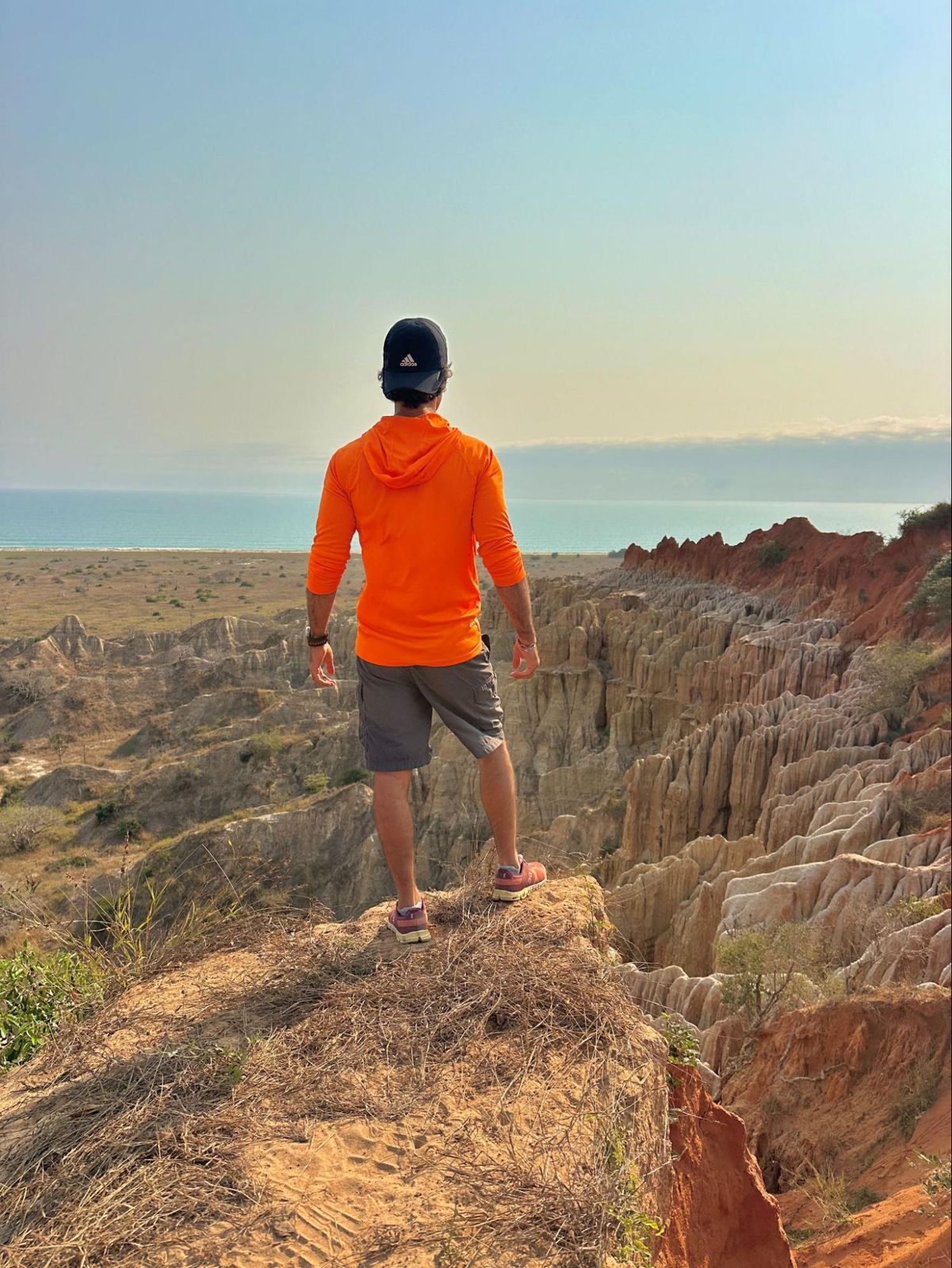
Miradouro da Lua and Mussulo: On the way back, we stopped at Miradouro da Lua, the Viewpoint of the Moon, where eroded cliffs of orange and white rock drop toward the ocean. It reminded me so much of the canyons I had seen in Kyrgyzstan and Turkmenistan.
Then Kenny had one last surprise for me: Mussulo, a classic weekend escape for people from Luanda, about a 15-minute boat ride from the city. I kept calling it an island, but it's actually a peninsula. With a DJ playing and beautiful homes along the water, it had a super relaxed vibe that reminded me of Lido Isle in Newport Beach, California. We walked along the beach as the sun went down. What a perfect way to spend my last day!
Running the Marginal: The next morning, I kept up my tradition of going for a run in every new country with a 5-kilometer run along the Marginal, a great way to close out my eventful and fulfilling first trip to Angola.
AFTERWORD
My trip to Angola was way too short. But I'm so happy I had the chance to learn about its complicated history of slavery, colonialism, communism, and eventual triumph.
I loved seeing the energy of a city that's changing so quickly, along with the food, the art, and the little taste of nature I got outside the capital. And of course, there was Kenny, who took me everywhere and made my journey truly unforgettable.
I left with a lot of hope for Angola's future and a long list of places I still need to see, starting with those waterfalls. Obrigado, Angola!
TRAVEL TIPS
BUILD IN A BUFFER: Flights in and out of Luanda, especially regional TAAG routes, can be canceled. Don't schedule your most important excursion for the day after you arrive, and leave a spare day if you can.
KALANDULA FALLS: The falls are a long drive east of Luanda, so plan for at least an overnight trip with a guide rather than trying to squeeze it into a single day.
KISSAMA NATIONAL PARK: If wildlife is your priority, go with a guide who can take you deeper into the park. And never get out of your vehicle on a safari drive.
PHOTOS: Don't take pictures of government buildings or military installations, in Luanda or anywhere else in the country.
DIAMOND AREAS: Avoid restricted diamond-mining regions such as Lunda Norte.
Stay Curious. And I look forward to seeing you on my next Final50 journey!
Travel Note: The information in this blog reflects my experience at the time of travel. Visa requirements, transportation, costs, and other travel conditions may change, so always verify the latest information before planning your trip.